SPACE IS NO LONGER A ONE WAY TRIP.
SINGULARORBIT, LLC is the first commercial service provider to have the ability to remove satellites and other orbital assets from LEO without using atmospheric re-entry to destroy them. Our Satellite Return Active System (SaTRAS) deplots on-orbit to capture the asset and return it safely to earth for re-use, recycling or re-purposing.

PROGRAMS
Satellite Return Active System [SaTRAS]
Mankind has gotten pretty good at getting things into Low Earth Orbit (LEO). In all cases, that has been a one-way trip for the payload. Today SINGULARORBIT, LLC has the ability to change that with their return as a service deployment of their SaTRAS system. The concept is simple, but the engineering was challenging. Launch a chaser vehicle into a convergance orbit with the target vehicle. Capture and secure the target vehicle. Re-enter without damaging either the chaser or target vehicle. Repeat.
The only satellite returns that were successful were on STS flights 31, 51A and 80. Those flights (Discovery and Columbia) used the Space Shuttle Orbiters huge cargp bay and robotic arm to capture and stow the satellites inside the bay. As of today there are over 3,500 satellites in low-earth orbit alone.
Aerospace Engineering Services
SINGULARORBIT, LLC now offers engineering services for aerospace clients. Our highly talented staff can augment your workforce, or completely take in your design, analysis or testing project.
Some of we offer:
Design
- From CONOPS to CAD we can support your needs and support your SIEMENS workflow with NX, Teamcenter, Altair, and NX NASTRAN (FEA).
- Systems level engineering usiong MBE/MBSE
Analysis
- We support most mainstream analysis packages.
- Support for FEA, CFD, Thermal and NvH
Concept and Proposal
- We create high-end, aerospce focused proposals in conjunction with your team.
- Concept artwork and mechanical animations
X-70 VULCANEER
X-70 VULCANEER
UPDATES
UPDATE: SINGULARORBIT to offer satellite capture and return mission operations for both commercial and government clients in 2028. New client positions to open Fall of 2027.
Satellite Return Active Systems (SaTRAS) is a service developed and deployed exclusively by SINGULARORBIT, LLC.
October 12, 2026 - SINGULARORBIT, LLC announces expanded engineering services division. By leveraging partnerships with existing companies, SINGULARORBIT can now offer services to established aerospace partners in enginering, test, analysis and advisory roles.
October 12, 2026 - SINGULARORBIT, LLC is proud to announce their new board seat memberships for Mr. Duane N. Redding, Dr. Steven F. Isenberg, Dr. Andrew Motes, Jay Kalath, and Scott Manley. Interviews are currently underway to fill the remaining seats, and an announcement will be made once the effoer is completed.
September 20, 2026 - SINGULARORBIT, LLC to team with NASA AMES via NASA's Technology transfer program aimed at fast-tracking new and emerging technology into the commercial arena.
ORBITAL ASSET RECOVERY IN THREE PHASES.
PHASE 01
Small Satellites
Phase 01 return technology will focus on smaller, lighter satellites that are in stable orbits, but taking up space none-the-less. These will range from the standard Smallsat up to minor scientific platforms. The assets will be recovered using the Orbital Capture Vehicle (OCV) and will be flown in a standard single or multi-unit configuration. Many of these assets will have the classification of 'space junk' but will have minor residual value. Using our OCV technology, SINGULARORBIT can retrive the on-orbit and replace it with an updated model if the client desires.
PHASE 01 - Typically 100 to 500Kg in mass.
PHASE 02
Mid-class Spacecraft
Phase 02 will focus on general satellite configurations recognized in the Medium designation. This category covers a diverse mix of mid-sized spacecraft, including various modern navigation and Earth observation satellites. These systems often have multiple deployed mechanical devices (solar arrays, antenneas, etc.) and will pose a larger rish to the OCV if in an unstable (rotation) pattern. These typically have amuch higher residual value due to hardware deployed for various missions and on-orbit requirements.
PHASE 02 - Typically 500 to 1000Kg in mass.
PHASE 03
Full Scale Satellites
Phase 03 will focus on the largest satellite systems. These are the traditional workhorses of the industry. A typical large satellite can weigh in around 6,500 kg each, as are powerful Earth observation satellites like GOES-R and the two current LANDSAT satellites. The majority of the very largest satellites are found in geostationary orbit (GEO) — about 22,300 miles above Earth. This is the highest altitude at which human-made satellites function. The VULCANEER Heavy Return Vehicle (HRV) will be the only way to safely return these to the earth without damaging them during re-entry
PHASE 03 - 1,000 to 2,200+Kg in mass.
MISSION - RETURN THE RELIC
BRINGING
VANGURD 1
HOME
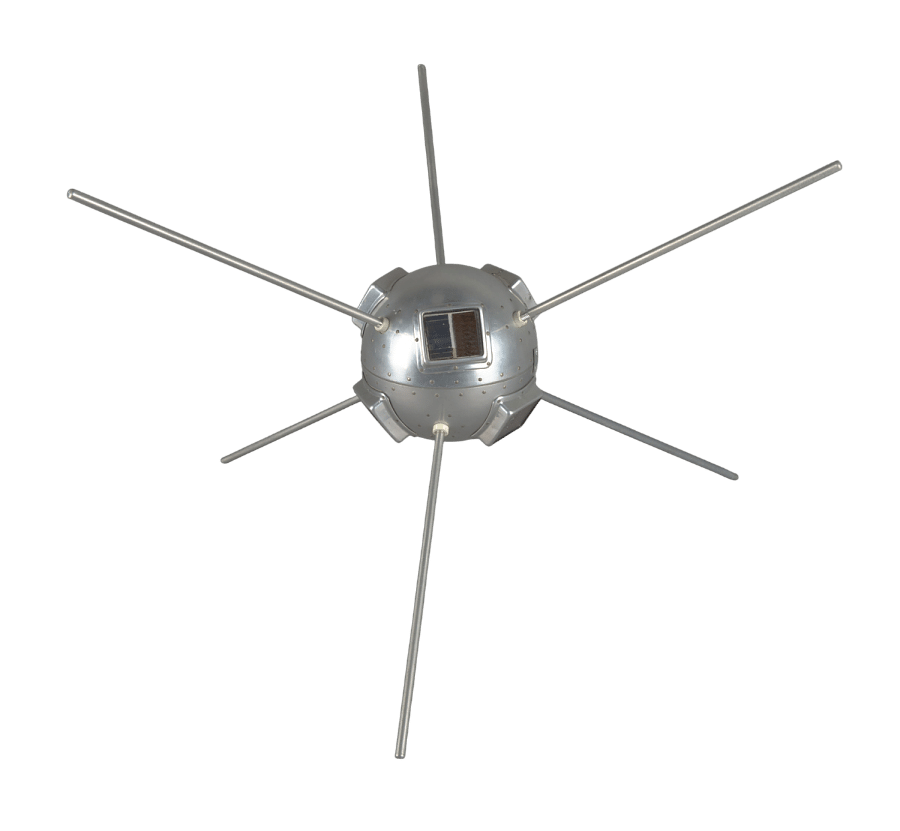
Vanguard 1 is the oldest human-made object still in orbit — a small, solar-powered satellite from the dawn of the Space Age that has circled Earth ever since.
The Relic mission will capture it and return it to the United States in 2033, its 75th year in orbit.
DESIGNATION
LAUNCHED
YEARS IN ORBIT (2033)
PLANNED RETURN
1958-002B
MARCH 17, 1958
75
UNITED STATES, 2033


WHY BRING IT HOME.
01
History
Preserve the oldest artifact of the Space Age. Vanguard 1 is mankinds oldest satellite still remaining.
02
Science
We can study 75 years of space exposure on real hardware. This is an unparrelled oppurtunity for science.
03
Debris
Recovering Vanguard 1 isn't just for history and science; it's also setting a standard by removing a long-lived objest from orbit.
04
Enviroment
This effort demonstrates respondsible stewardship of space and our orbital pathways that we now rely so heavily upon.
05
Time Capsule
This will return a message (and the messenger) from the small group of engineers who launched Vanguard 1 in 1958.
THE NEXT STAGE IN SPACE RECOVERY
SINGULARORBIT
X-70 'VULCANEER'

Above: Artist conception of the X-70 VULCANEER